
Here is a figure that comes up repeatedly in wardrobe research: most people wear roughly 20% of their clothes 80% of the time. The other 80% hangs untouched, taking up space, and making the usable portion harder to find each morning.
Most closet organization advice skips why this happens. It isn’t a storage problem. It’s a volume and decision problem. The hacks below work best when applied in the right order — and that order matters more than any single product you can buy.
The Step That Comes Before Every Other Hack
Every professional organizer — from Marie Kondo to the team behind The Home Edit — agrees on one thing: you cannot organize clutter. Reduction of volume always comes first. Most people skip this entirely because it feels like a different task from organizing. It isn’t. It’s the same task.
Buying shelf dividers and velvet hangers for a closet holding 200 items you don’t wear is like installing a new filing system for documents you were going to shred anyway. The system looks good for two weeks. Then the overflow begins and the whole thing unravels faster than it came together.
The One-Year Rule Is Too Simple
“If you haven’t worn it in a year, donate it” is a useful starting point, but it breaks down at the edges. A formal gown worn once every 18 months is still a legitimate wardrobe item. A basic black turtleneck you haven’t touched in 14 months because it’s buried behind three others might be your most-worn piece once it’s actually accessible.
A more reliable question: pull everything out of the closet — everything — sort by category, and ask yourself about each item: would you buy this again today? Not “is it in good condition” or “did it cost a lot.” Would you actually repurchase it at full price, right now? That question cuts through sentiment faster than any timeline-based rule.
Category Sorting vs. Color Sorting
Most organization systems default to color sorting because it photographs well. In practice, most people don’t think “I want something blue” when getting dressed. They think “I need a blouse” or “I need something for a meeting.”
Category sorting — all shirts together, all trousers together, all outerwear together — consistently works better for daily use. Within each category, a secondary sort by color or by fabric weight (light to heavy) adds speed without the confusion of a color-first system that scatters your blouses across four different sections of the closet.
The Outflow Problem Nobody Fixes
New clothing arrives regularly. Nothing forces old items out. An organized system delays the creep, but it doesn’t stop it. The most reliable fix is a designated donation bag or box, permanently installed inside or directly beside the closet. When something stops earning its place, it goes there immediately — not to the chair, not to “deal with later.” That single habit maintains closet systems better than any product on the market, and it costs nothing to implement.
What Closet Organizers Are Actually Worth Buying

The closet organizer market spans from $3 velvet hangers to $3,000 custom built-ins. Most people overspend on visible but low-impact items and underspend where it actually matters. The table below reflects what delivers consistent value versus what looks better in marketing photos than in a real closet.
| Product | Approx. Price | Best For | Honest Assessment |
|---|---|---|---|
| Velvet hangers (e.g., Huggable Hangers, 50-pack) | $20–$35 | Every closet, immediately | Best single upgrade available. Saves 30–40% horizontal rod space over wire or chunky plastic. No meaningful downsides. |
| IKEA SKUBB storage boxes (6-pack) | ~$10 | Shelf-top storage, accessories | Excellent value. Works well for folded scarves, belts, and small accessories. Fabric sides wear at corners over time. |
| Clear stackable shoe boxes (e.g., IRIS USA, 6-pack) | $28–$45 | Shoe collections over 15 pairs | Better than original shoe boxes. Stackable and visible. Much cheaper than drop-front acrylic displays with similar results. |
| Hanging fabric shelf organizer (e.g., StorageWorks 6-shelf) | $18–$28 | Closets with a single rod and no shelves | Adds 4–6 usable shelves in dead vertical space below hanging items. Not load-bearing — keep to folded sweaters and soft goods. |
| OXO Good Grips shelf dividers (set of 2) | ~$15 | Folded stacks on open shelves | Stops the avalanche effect on sweater and jean stacks. Clips onto existing shelves in seconds. Underrated and underused. |
| Spacesaver vacuum storage bags (6-pack) | ~$35 | Seasonal bulky items | Compresses duvets and winter coats by up to 80%. Requires a vacuum and 10 minutes per season change. Genuinely useful for off-season storage. |
| Elfa System (The Container Store) | $150–$600+ | Walk-in closets with bare walls | Modular, wall-mounted, fully adjustable. Worth the investment if you plan to stay in the space three or more years. Overkill for a standard reach-in closet. |
The one product most people skip that makes the biggest single difference: velvet hangers. Switching from wire or bulky plastic to slim velvet hangers typically recovers 10–15 inches of horizontal rod space in a standard reach-in closet. That often eliminates the “clothes falling off the end” problem and the crowding that makes items invisible. It’s the least exciting upgrade and the most impactful one.
Six Closet Hacks That Hold Up Over Time
These work across different closet configurations and don’t require renovation or a contractor. Most cost under $30. Listed roughly by impact relative to effort required:
- Switch every hanger to a uniform slim velvet style. Wire hangers take up nearly one inch each; slim velvet hangers take up about a quarter inch. A rod holding 40 wire hangers can hold 70–80 velvet ones. Huggable Hangers — Joy Mangano’s original version — remain the category standard. Non-slip texture also stops the “everything slides to the center” pile-up.
- Add a second hanging rod below your shortest items. Jackets, shirts, and blazers typically hang to 36–40 inches. That leaves two to three feet of dead vertical space below them. A hanging rod extender (around $8–$15) drops into that space and doubles hanging capacity for short items. No tools, no installation, immediate result.
- Store seasonal items somewhere other than the main closet. The closet’s most valuable real estate is at eye level and arm’s reach. Winter coats in July and swimwear in January should not occupy that zone. Spacesaver vacuum bags under the bed or in secondary storage free up the prime space for what you’re actually wearing right now.
- Use shelf dividers on open shelving. Folded sweaters and jeans fall sideways without boundaries. OXO Good Grips dividers clip onto existing shelves and hold stacks vertical. They prevent the slow collapse that turns a neatly folded pile into an unusable heap within a week of organizing.
- Group by outfit logic within categories. If you always wear the same blazer with the same trousers, hanging them together saves decision time each morning. Most professional organizers recommend a hybrid approach: category first, then outfit proximity within each category. It sounds minor and adds up quickly.
- Label anything above or behind eye level. Top shelves and behind-door pockets are “out of sight, out of mind” zones. Basic label tape on bins turns those dead zones into functional storage rather than the place items go to disappear. A label maker is optional — masking tape and a marker work identically.
Matching the Strategy to Your Closet Type
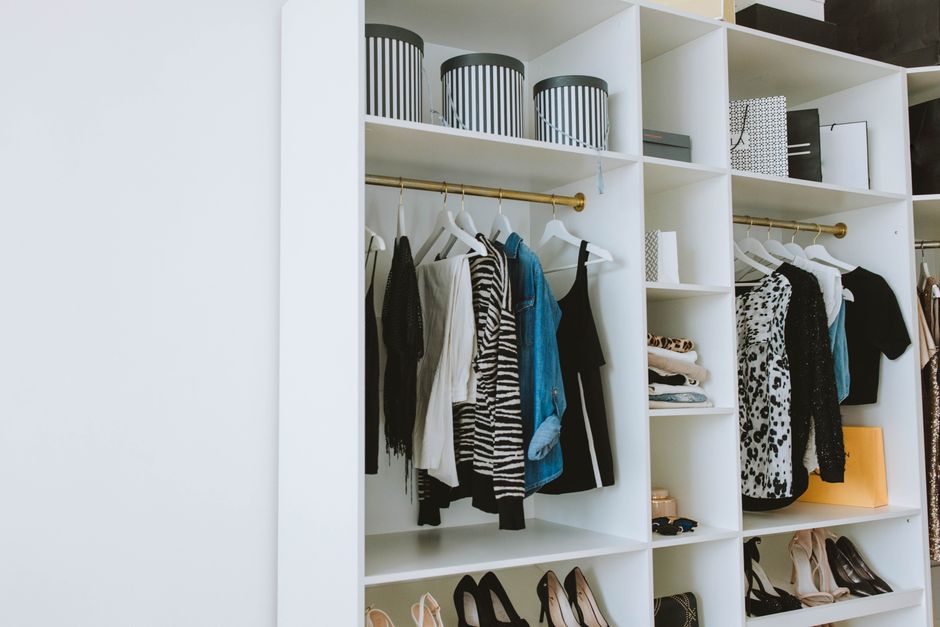
What if my closet is a single rod with no shelving?
This is the most common reach-in configuration, and it responds well to low-cost fixes. A hanging fabric shelving unit like the StorageWorks 6-shelf canvas organizer (around $20) attaches directly to the existing rod and creates vertical storage for folded items that currently have nowhere to go. Add a rod extender below your shortest hanging items and you’ve effectively tripled the usable capacity without touching a wall. Total investment: under $35, no tools required.
What if I have a walk-in closet but it’s still chaotic?
Walk-in chaos is almost always a volume problem, not a system problem. The space is generous enough that there’s no pressure to edit — everything fits, just badly. A serious purge comes before any system in this case.
If the walk-in has bare walls or inefficient wire shelving, a modular wall system makes sense. The IKEA PAX system starts around $100–$300 depending on configuration and provides fixed compartments. The Elfa system from The Container Store costs more but is fully wall-mounted and can be reconfigured as needs change. The PAX wins on budget; Elfa wins on flexibility and longevity.
What about shared closets?
Shared closets work best with clearly divided zones rather than integrated systems. Trying to sort two people’s wardrobes together by category creates constant renegotiation about whose items go where. A clean left-right or front-back split — with each person responsible for their own zone — holds better over time. The one shared standard that makes a meaningful difference: consistent hanger type across both zones. Mixed hanger styles across a shared closet is one of the fastest routes to permanent visual chaos.
Why Most Organized Closets Fall Apart Within 90 Days

The system works. The habits don’t.
Every organized closet runs into the same failure mode: new items arrive and nothing forces old items out. An organized closet with 80 items stays organized. The same closet with 120 items, three months after a complete overhaul, often looks worse than it did before the project started — because now the system is strained and the disorder feels more conspicuous.
The only maintenance habit that consistently holds is one-in, one-out: every new item that enters the closet triggers the removal of one item. Not eventually. At the same moment. The permanent donation box mentioned earlier is the physical mechanism for this rule. Without it, the system degrades on a predictable 60–90 day timeline regardless of which bins, hangers, or shelf dividers were installed.
Storage products and organizational systems have improved considerably — from basic wire shelving to modular wall systems that rival custom carpentry at a fraction of the price. As those tools keep improving, the limiting factor stays the same: the regular habit of editing. The closets that stay organized aren’t the ones with the most sophisticated systems. They’re the ones where someone decided what the space is actually for and kept it that way.