
You don’t need a six-figure wardrobe to dress well. But you do need to stop making the same tired errors that make you look sloppy, dated, or like you just don’t care. I’ve spent years in retail and tailoring, and I’ve seen the same mistakes ruin otherwise decent outfits. Here are the ten worst offenders — and exactly how to fix each one.
The Baggy Suit: Why It Makes You Look Shorter and Heavier
A suit that fits poorly is the single most expensive mistake you can make. And I’m not talking about off-the-rack vs. bespoke. I’m talking about guys who buy a 42 Regular when they need a 40 Short, then wonder why they look like they’re wearing their father’s clothes.
The problem is simple: excess fabric. When your shoulders droop past your natural shoulder line, when the jacket waist hangs straight down instead of nipping in, when the pants bunch around your ankles — you add visual weight and lose height. A man who is 5’10” in a well-fitted suit looks 5’10”. That same man in a baggy suit looks 5’7″ and 20 pounds heavier.
The fix: Spend $75–$150 on alterations. Take the jacket sleeves up so a half-inch of shirt cuff shows. Hem the pants so they break once on your shoe, not pool in a heap. Take in the jacket waist so it follows your body’s curve. A $400 SuitSupply jacket tailored to your body will look better than a $2,000 Brioni that hangs off you.
If you’re buying new, look for brands that offer short and long lengths. Brooks Brothers, SuitSupply, and even J.Crew all carry proper sizing. Never buy a suit off the rack without trying the size up and down from your guess.
Shoes That Scream “I Don’t Care”

Your shoes are the first thing people notice and the last thing you think about. That’s a problem. I see men in $1,500 suits walking around in scuffed, square-toed, or — worst of all — sneakers that look like they’ve survived a war.
The mistake isn’t just neglect. It’s buying the wrong shoe in the first place. Square-toed dress shoes make your feet look like duck flippers. They were trendy in the late 1990s and should have stayed there. Bulky athletic sneakers with chinos or jeans make your outfit look confused — are you going to the gym or brunch?
Here’s what you need instead:
- One pair of plain-toe oxfords in black or dark brown. Allen Edmonds Park Avenue ($425) is the gold standard. Meermin ($200) is the best value.
- One pair of clean white leather sneakers. Common Projects ($400) are iconic. For a budget option, the Veja Esplar ($150) or even a clean pair of Stan Smiths ($90) work if you keep them white.
- One pair of brown chukka boots. Clarks Desert Boots ($120) are the classic. They go with jeans, chinos, and even some casual suits.
Keep them clean. Resole them when the heel wears down. A man who takes care of his shoes signals that he takes care of everything.
Ill-Fitting T-Shirts: The $10 Ruin
A bad T-shirt can wreck an otherwise solid outfit faster than anything. And most men wear T-shirts that are too big, too small, or too worn out to be worn in public.
The classic error: buying a pack of Hanes Beefy-Ts in size Large because that’s what you wore in college. Now you’re 35, and that shirt hangs past your crotch with sleeves down to your elbows. You look like you’re wearing a tent.
The fix: A T-shirt should end at your waistband, not below it. The shoulder seam should sit right at the edge of your shoulder, not halfway down your arm. The sleeves should hug your biceps, not flap around. If you can pinch more than an inch of fabric at your sides, the shirt is too big.
Brands that get this right: Uniqlo Supima Cotton Tees ($15) have a slim but not tight cut. Next Level Apparel (about $10 on Amazon) makes a fitted crewneck that punches way above its price. For a premium option, Buck Mason’s Pima Crew ($45) keeps its shape wash after wash.
And for the love of God, retire any T-shirt with stains, holes, faded graphics, or a stretched-out collar. Those are for painting or sleeping, not leaving the house.
Belts and Shoes That Don’t Match
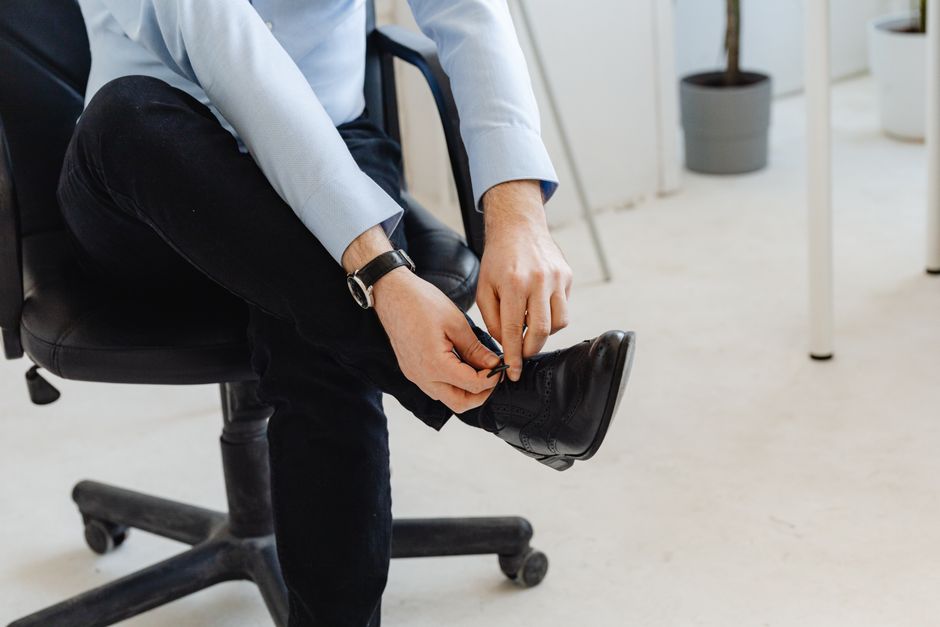
This one is so easy to fix that there’s no excuse. Yet I see it constantly: black shoes with a brown belt. Or worse, a braided leather belt with a smooth leather shoe. It’s like wearing a striped tie with a plaid shirt — it screams that you didn’t look in the mirror.
The rule is straightforward: match your belt to your shoes in color and finish. Black shoes = black belt. Brown shoes = brown belt. Oxblood shoes = oxblood belt. The belt should be the same width as your belt loops — a 1.25-inch belt for standard loops, 1.5 inches for jeans.
Exceptions: Casual outfits with sneakers can handle a woven or canvas belt. A navy suit with brown shoes looks fine with a brown belt. But if you’re wearing dress shoes, the belt matches. Period.
Invest in two quality belts: one black, one brown. Anson Belt ($40) makes a no-hole ratcheting system that’s infinitely adjustable. Tanner Goods ($90) makes leather belts that will last a decade. Both are better than buying five cheap belts that crack and curl.
The Button-Down Collar Disaster
Button-down collars are for casual and business casual settings. They are not for suits. Yet I see men wearing a Brooks Brothers button-down under a suit jacket, and it drives me nuts.
The button-down collar was invented for polo players — the buttons kept the collar from flapping in the wind. It has a softer, more relaxed look. When you wear it under a suit, the collar points curl up and look messy. You need a spread collar or a point collar with collar stays for a suit.
Here’s the breakdown:
| Collar Type | Best With | Worst With |
|---|---|---|
| Button-down | Jeans, chinos, sport coats, no jacket | Suits, especially with a tie |
| Spread collar | Suits, ties, formal wear | No jacket, untucked |
| Point collar | Suits, ties, business casual | Very casual outfits |
| Mandarin (band) collar | Casual, no tie, summer | Suits, formal events |
The fix: Own at least two spread-collar dress shirts for suit days. Charles Tyrwhitt and TM Lewin both sell them for around $40–$60 and they include metal collar stays. For casual, keep the button-downs — just don’t wear them with a tie and jacket.
Socks That Ruin the Line

Your socks are doing more damage than you think. Three specific mistakes kill the look:
1. White athletic socks with dress shoes. This is the original sin of men’s fashion. White tube socks belong in the gym. When you wear them with oxfords or loafers, you break the visual line from pants to shoes and look like a tourist. The fix: Dress socks in navy, charcoal, brown, or black. They should be thin and reach mid-calf so no skin shows when you sit down.
2. No-show socks that show. No-show socks are great for loafers and boat shoes — until they slip off your heel and become visible. Then you look like you’ve given up. The fix: Buy no-show socks with silicone grip strips on the heel. Bombas ($12/pair) and Pair of Thieves ($10/pair) stay put. Replace them when the grip wears out.
3. Pattern chaos. A bold patterned sock can be a fun accent. But only if the rest of your outfit is neutral. Don’t wear neon argyle socks with a pinstripe suit. You’re not a clown. The fix: Keep patterned socks for casual outfits. With suits, stick to solids or subtle textures like ribbed or micro-dot.
Overdoing the Accessories
Less is more. I don’t care how cool you think that chunky watch, beaded bracelet, and pocket square look together. You look like you’re trying too hard.
The rule of three: no more than three accessories visible at once. A watch counts. A wedding ring counts. Glasses count. A bracelet counts. A pocket square counts. Pick three and stop.
Two specific accessories that men get wrong:
Watches that are too big. A 50mm dive watch on a 6-inch wrist looks absurd. The watch case should not overhang your wrist. For most men, 38mm to 42mm is the sweet spot. A Seiko SKX007 (42mm, $250) or a Timex Marlin (34mm, $180) are classic sizes that fit almost everyone.
Pocket squares that match the tie. This is a 1980s prom move. The pocket square should complement the tie, not match it. If your tie is navy with white polka dots, your pocket square should be white linen with a navy border — not the exact same polka dot pattern. The fix: Buy a pack of white linen pocket squares (Kent Wang sells them for $15 each). They go with everything.
Jeans That Fit Like a Garbage Bag
Men’s jeans fall into two bad camps: too baggy or too tight. Neither works.
Baggy jeans make your legs look short and your torso look long. They bunch up around your shoes and create a sloppy silhouette. Skinny jeans make your thighs look compressed and your feet look huge. They also — let’s be honest — look like you’re trying to be 22 again.
The fix: A straight or slim-straight leg. Not skinny. Not relaxed. Straight. The leg should follow the line of your thigh without squeezing it. The hem should rest on top of your shoe with a single slight break — no bunching, no flooding.
Brands that nail this cut: Levi’s 501 ($70) is the original straight leg. For a slightly trimmer fit, the Levi’s 511 ($70) works if you size up one in the waist. Bonobos Athletic Fit ($98) is great if you have larger thighs from cycling or lifting. Uniqlo’s Selvedge Straight ($50) is the best budget option.
Dark wash (indigo or black) is more versatile than light wash. Raw denim fades to your body over time and looks better the more you wear it. Avoid pre-distressed jeans with fake whiskering and holes — they look cheap.
The Wrong Outerwear for the Occasion
Your jacket is the first thing people see when you walk in. And most men wear the wrong one.
The biggest mistake: wearing a puffer jacket or a North Face fleece with anything other than gym clothes. These are performance pieces. They belong on trails, not at dinner. They add bulk, don’t flatter your shape, and make every outfit look casual — even if you’re wearing nice pants underneath.
What to wear instead:
- For fall/spring: A field jacket in olive or khaki. Barbour Bedale ($350) or a cheaper alternative like the LL Bean Field Coat ($199). It’s casual but structured. Works over a sweater or a button-down.
- For winter: A wool overcoat in charcoal or camel. It should hit just above the knee. J.Crew’s Ludlow Topcoat ($400 on sale) is a solid choice. It dresses up any outfit and keeps you warm without looking like you’re going camping.
- For rain: A trench coat or a waxed cotton jacket. Avoid the plastic-looking rain shells. Rains ($150) makes a clean minimalist raincoat that looks sharp.
One more thing: your jacket should fit over a suit jacket or a thick sweater. If you can’t lift your arms or button it without straining, it’s too small. If there’s enough room for a second person, it’s too big.
Ignoring Fabric Quality
This is the mistake that separates men who look good from men who look rich. Fabric quality matters more than brand names. A cheap polyester shirt from a designer label will always look worse than a well-made cotton shirt from an unknown brand.
Here’s what to look for:
- Suits and blazers: 100% wool. Super 120s or 130s for dressy, flannel or tweed for casual. Avoid polyester blends — they don’t breathe, they wrinkle, and they look shiny.
- Dress shirts: 100% cotton, preferably two-ply. Higher thread count (80s to 100s) feels better and lasts longer. Avoid non-iron shirts that are coated in formaldehyde — they feel stiff and don’t breathe.
- Knits (sweaters, cardigans): Cashmere or merino wool. A $100 Uniqlo cashmere sweater will feel better and last longer than a $200 acrylic sweater from a mid-tier brand. Cotton sweaters are fine for warm weather but don’t hold their shape as well.
- T-shirts: 100% cotton, preferably ring-spun or pima. Avoid tri-blends (cotton/polyester/rayon) — they pill and stretch out.
Check the care label before you buy. If it says “Dry clean only” on a casual shirt, think twice. If it says “100% polyester,” put it back on the rack. Your skin will thank you.
The single most important takeaway: Fit and fabric matter more than brand names and price tags — buy less, buy better, and take everything to a tailor.